Role permissions
Each permission controls specific actions users can perform within 247connect. By default, all permissions are set to Disabled when you create a new role. To enable a permission, select Enabled from the drop-down list.
-
When you clone a role, the new role inherits its permissions from the original role.
-
Permissions with the Account
 icon only have an effect when applied at account level.
 -
Changes to role permissions take effect when assigned users log out and log back in. Updates may take up to five minutes to apply.
Permission categories
The Role permissions tab displays permission categories in a tree view on the left side of the window.
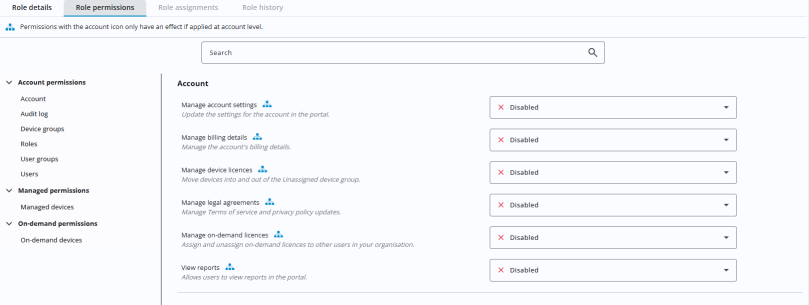
Select a category in the tree view to quickly navigate to that section of permissions.
All available permissions are displayed on the right side of the window and can be scrolled through independently of the selected category.
Use the search field to quickly find a permission.
Account permissions
Account
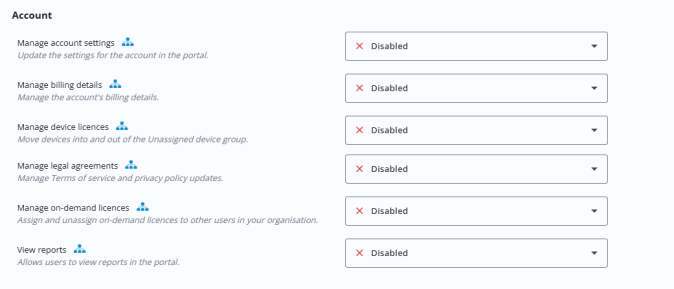
Manage account settings: Update the 247connect account settings.
Manage billing details: Manage the account's billing information.
Manage device
Manage legal agreements: Manage updates to the terms of service and privacy policy.
Manage on-demand
View reports: Enable users to view reports in the Web Portal.
Audit log

View audit log: View audit log entries for 247connect.
Device groups
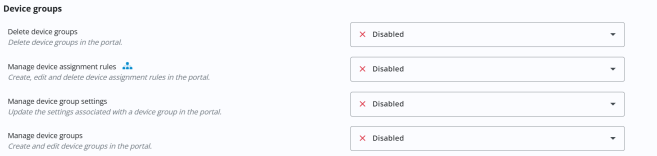
Delete device groups: Remove existing device groups.
Manage device assignment rules: Create, edit, and delete device assignment rules.
Manage device group settings: Configure the device group settings.
Manage device groups: Create and edit device groups.
Roles

Delete roles: Remove roles that are no longer needed.
Manage role assignments: Assign and unassign roles for users at both the account and device group levels.
Manage roles: Create and edit roles.
User groups

Delete user groups: Remove user groups that are no longer needed.
Manage user groups: Create and edit user groups.
Users
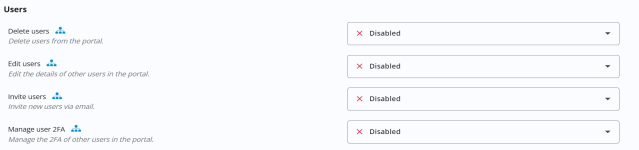
Delete users: Remove users from the Web Portal.
Edit users: Edit the details of other users.
Invite users: Invite new users to join via email.
Manage user 2FA: Manage the two-factor authentication (2FA) of other users in the Web Portal.
Managed permissions
Managed devices
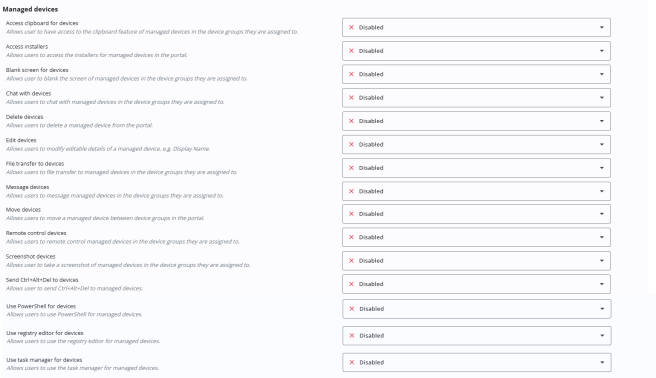
Access clipboard: Access the clipboard of managed devices.
Access installers: Access to the installers for managed devices in the Web Portal.
Blank the screen: Blank the screen on managed devices during a session.
Chat: Chat with managed devices.
Delete devices: Remove a managed device from the Web Portal.
Edit device details: Modify the editable details of a managed devices, for example, the display name.
File transfer: Transfer files directly to managed devices.
Message: Send messages directly to managed devices.
Move devices: Move managed devices between device groups.
PowerShell: Run PowerShell commands on managed devices.
Registry Editor: Use the Registry Editor for managed devices.
Remote control: Remote control managed devices.
Screenshot: Take a screenshot of managed devices.
Send Ctrl+Alt+Del: Send Ctrl+Alt+Del to managed devices.
Task Manager: Use the Task Manager for managed devices.
On-demand permissions
On-demand devices
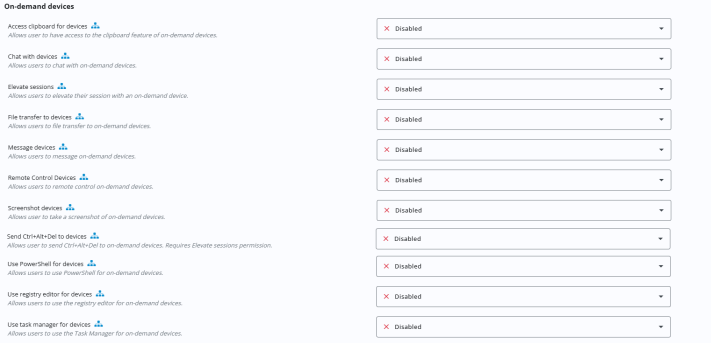
Access clipboard: Access the clipboard of the on-demand device.
Chat: Chat with on-demand devices.
Elevate sessions: Elevate their session with an on-demand device.
File transfer: Transfer files directly to on-demand devices.
Message: Send messages directly to on-demand devices.
PowerShell: Use PowerShell for on-demand sessions.
Registry Editor: Use the Registry Editor for on-demand devices.
Remote control: Remote control on-demand devices.
Screenshot: Take a screenshot of on-demand devices.
Send Ctrl+Alt+Del: Send Ctrl+Alt+Del to on-demand devices.
Task Manager: Use the Task Manager for on-demand devices.


