Manage account settings
You can configure key account-wide preferences, branding, security settings and integration options.
Access account settings
-
In the 247connect Web Portal, go to Account > Settings in the side menu.
-
Use the tree view on the left side of the window to select one of the following pages:
-
Settings
-
Microsoft integration
-
ServiceNow integration
-
Halo integration
-
Salesforce integration
-
Settings
The Settings page contains account-wide configuration options, including custom branding, invitation settings, user profile settings, security settings, remote session idle timeout and display name settings.
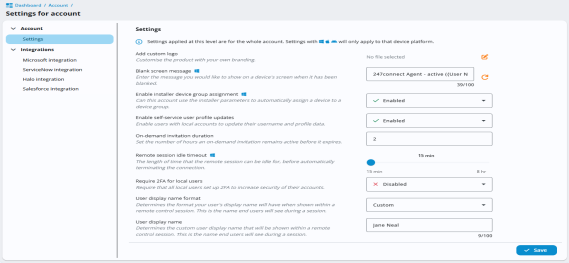
Add custom logo
-
To upload a logo, click Edit
 and select Choose file.
 -
To remove the logo, click Edit
and then Delete .
.
-
Logos must be in .jpg, .jpeg or .png format and no larger than 3MB.
-
The size of the custom logo in the Agent window is 312 x 79 pixels (approximately 4:1). 247connect resizes the logo to fit but does not change its aspect ratio.
Blank screen message (Windows only)
Enter a custom message to display on the device's screen when you blank it. By default, the message is: 247connect Agent - active {{User Name}}. To change it, type over the text. To revert to the default message, click the Reset to default icon.
icon.
Enable installer device group assignment (Windows only)
Set whether this account can use the installer parameters to automatically assign a managed device to a device group during installation. For details on how to do this, see Assign Windows managed devices to a device group during installation.
Enable self-service user profile updates
Enable users with local accounts to update their own profile information, including their username.
On-demand invitation duration
Set how long an on-demand invitation stays active before it expires. By default, invitations expire after 2 hours. You can change this time, up to a maximum of 24 hours.
Remote session idle timeout (Windows only)
Set how long a remote session can remain idle before 247connect automatically disconnects. Use the slider to set a timeout between 15 minutes and 8 hours.
Require 2FA for local users
Improve the security of local users' accounts by requiring them to set up and use two-factor authentication (2FA).
User display name format
Choose how user names are shown to end users during remote control sessions:
-
First name and last name: Example, John Smith.
-
Email: Example j.smith@247connect.com.
-
Custom: Enter a custom name, such as Supported by Your Company Name. This applies to all sessions.
User display name
If you select Custom, enter the name you want end users to see.
Click Save.
Settings take effect immediately and apply to all remote control sessions.
Microsoft integration
Linking your Microsoft account enables 247connect to access the data needed to support rule-based device assignment.
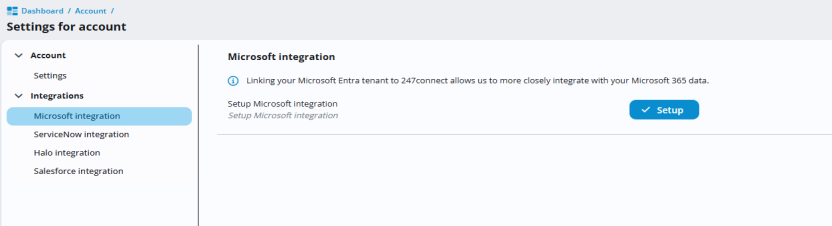
Setup Microsoft integration
Click Setup to connect your Microsoft 365 account. Sign in with your Microsoft Entra ID administrator account and review the required permissions (see Microsoft Graph permissions for details).
After authentication, your tenant details are displayed. If additional permissions are added in the future, you can click Update Consent to approve them.
Click Save.
ServiceNow integration
Use these settings to control what information 247connect sends to ServiceNow.
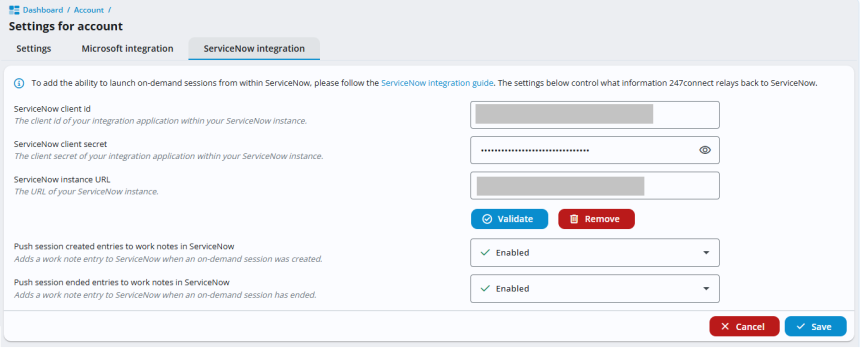
ServiceNow Client ID
Enter the Client ID from your ServiceNow integration application.
ServiceNow Client Secret
Enter the Client Secret associated with your integration application.
ServiceNow instance URL
Enter the URL of your ServiceNow instance.
To check the connection and confirm that the credentials are correct, click Validate and then click Save. If validation fails, review the details and try again. To remove the current configuration, click Remove.
Push 'session created' entries to work notes in ServiceNow
Adds a work note entry when a new on-demand session is created.
Push 'session ended' entries to work notes in ServiceNow
Adds a work note entry when an on-demand session ends.
Click Save.
Halo integration
Use these settings to control what information 247connect sends to HaloITSM.
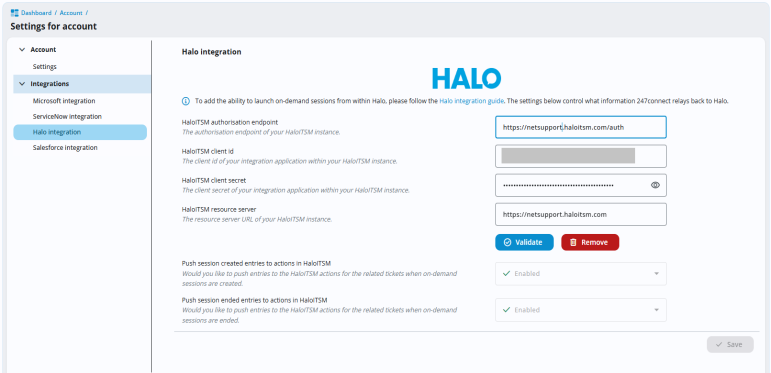
HaloITSM authorisation endpoint
Enter the Authorisation Server URL from your HaloITSM integration.
HaloITSM Client ID
Enter the Client ID of your integration application within your HaloITSM instance.
HaloITSM Client Secret
Enter the Client Secret of your integration application within your HaloITSM instance.
HaloITSM resource server
Enter the Resource Server URL from your HaloITSM integration.
To check the connection and confirm that the credentials are correct, click Validate and then click Save. If validation fails, review the details and try again. To remove the current configuration, click Remove.
Push session created entries to HaloITSM
Adds a ticket entry when a new on-demand session is created.
Push session ended entries to HaloITSM
Adds a ticket entry when an on-demand session ends.
Click Save.
Salesforce integration
Use these settings to control what information 247connect sends to Salesforce.
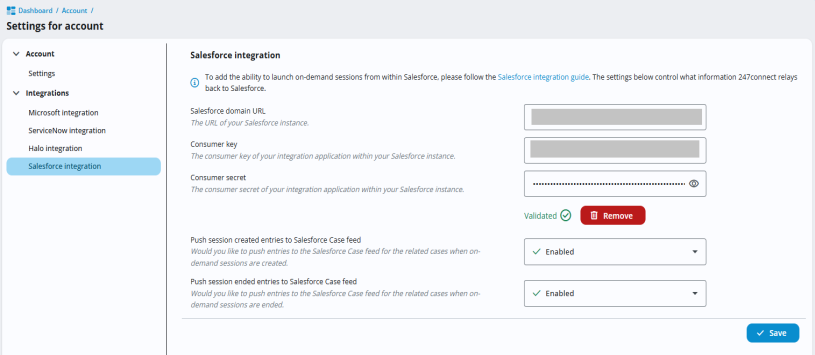
Salesforce domain URL
Enter your Current My Domain URL. You can find it in Salesforce under Setup > My Domain.
Consumer key
Enter the Consumer Key from your Salesforce External Client App.
Consumer secret
Enter the Consumer Secret from your Salesforce External Client App.
To check the connection and confirm that the credentials are correct, click Validate and then click Save. If validation fails, review the details and try again. To remove the current configuration, click Remove.
Push session created entries to Salesforce Case feed
Adds a Case Feed entry when a new on-demand session is created.
Push session ended entries to Salesforce Case feed
Adds a Case Feed entry when an on-demand session ends.
Click Save.
See also:
Setting up two-factor authentication (2FA)
Integrate 247connect with ServiceNow
Integrate 247connect with HaloITSM
Integrate 247connect with Salesforce


